← Projectswrite-up
What Sells at the CWRU Bookstore
A group marketing-research project: a 49-response student survey analyzed with pandas, logistic regression and K-means to find out who buys campus apparel and what would sell more.
What Sells at the CWRU Bookstore is a marketing-research project for a course at Case Western Reserve University. We surveyed students about apparel at the campus bookstore to find out who plans to buy, what they want, what they will pay and which promotions would move them.
It was a group project.
- Source code and data: github.com/rcorrie325/Marketing
The question
The bookstore wants to sell more clothing. The survey was built around its decisions: which products and designs to stock, in-store vs. online, how to advertise and how to price. The analysis asks who is likely to buy next semester, whether students fall into distinct segments, and whether men and women want different things.
The data
- A Qualtrics survey of CWRU students: 51 responses, 49 after cleaning. The two removed responses were screened out after the first question and answered nothing else.
- 28 men, 19 women and 2 non-binary respondents; almost all undergraduates.
- Personal metadata (IP addresses, location and recipient fields) was removed from the published data and from the repository history.
- It is a small convenience sample, so every result here is directional.
Methods
- Cleaning and descriptive statistics in pandas: Likert answers mapped to 1–4 scores, spending brackets to 1–6.
- Logistic regression for purchase intent ("likely" or "very likely" to buy next semester: 15 of 49). Tuning and feature selection run inside each training split, and accuracy comes from nested cross-validation (5-fold × 20 repeats), compared with a majority-class baseline.
- K-means segmentation on five standardized answers (purchase intent, ad responsiveness, spending), with k chosen by silhouette score.
- Male vs. female comparisons with within-gender percentages and Welch's t-tests.
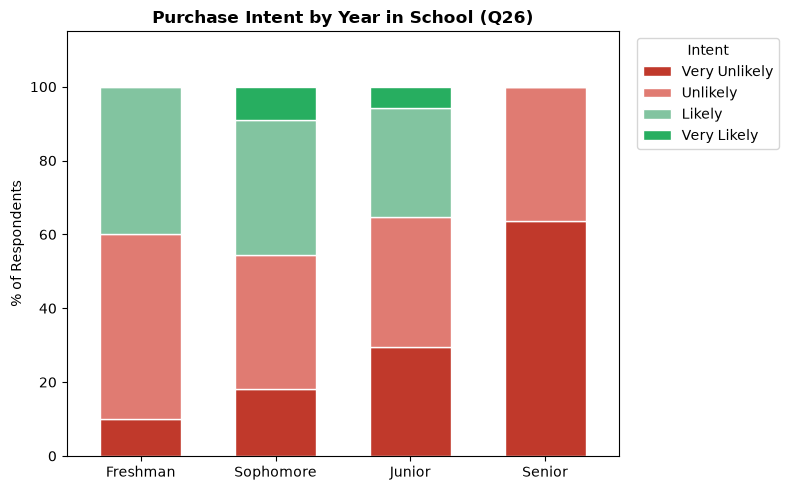
Purchase intent next semester by year in school. No senior says they are likely to buy.
Findings
- Purchase intent is low. Only 31% say they are likely to buy bookstore clothing next semester, even though 76% have browsed the bookstore and 67% have bought from it before.
- Seniors are the hardest sell. None of the 11 seniors is likely to buy, against 40% of freshmen, 45% of sophomores and 35% of juniors.
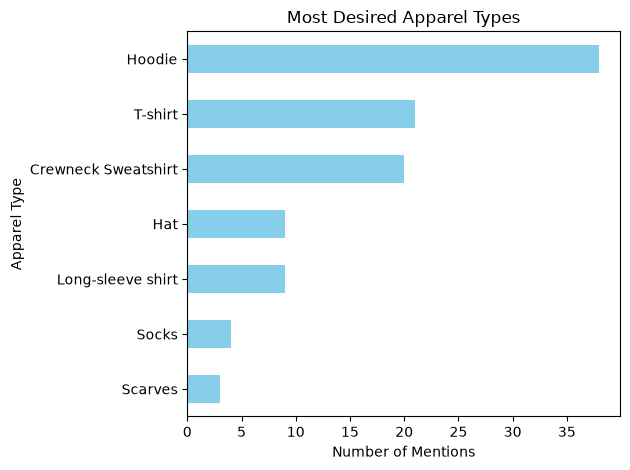
- Hoodies first. Hoodies are the most wanted item (38 of 49 respondents), well ahead of T-shirts (21) and crewnecks (20).
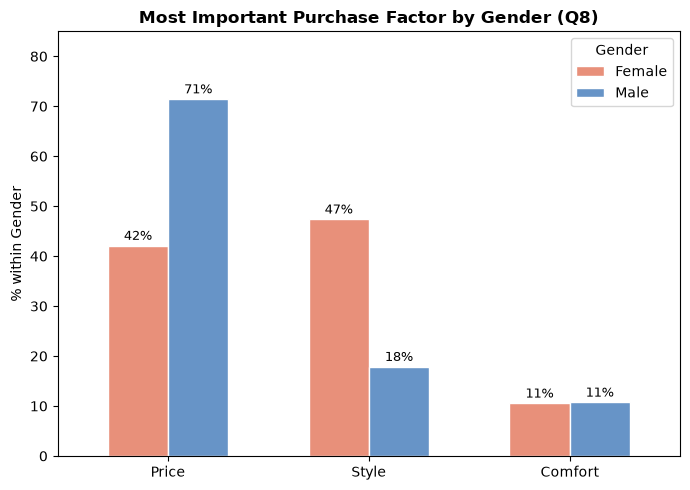
- Price matters most, with a gender split. 57% name price as their top purchase factor: 71% of men, while women split between style (47%) and price (42%).
- Money-saving promotions work. 73% say discounts would be the most persuasive online ad, 69% say free giveaways would draw them to an in-person promotion, and Instagram reaches 90% of respondents.
- No significant gender differences in purchase likelihood, ad responsiveness or spending (all p > 0.19).
An honest look at the model
The first version of the purchase-intent model reported 75% accuracy. Rechecking it turned up two problems: one real respondent had been dropped by mistake, and the model's features and settings were chosen using the same data it was scored on. With all 49 responses and nested cross-validation, the full model scores 66% and the reduced five-feature model 69%, against 69% for simply predicting "unlikely" for everyone. In other words, these survey answers don't predict purchase intent at this sample size.
The features the model kept most consistently (online-ad responsiveness, year in school and price as the top factor) still line up with the cross-tabs above, so they are worth testing with a bigger survey.
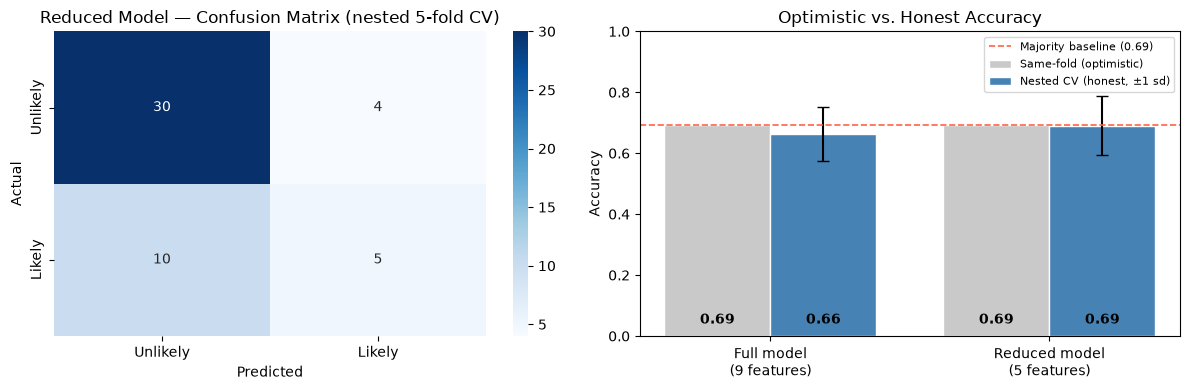
Honest (nested CV) accuracy against the majority-class baseline.
Segments
K-means found three groups: higher-spend, low-intent students (24) who spend the most on clothing but don't plan to buy here, high-intent, ad-responsive students (16), and low-intent, price-sensitive students (9). For the bookstore that points to premium, style-led pieces for the first group and promotions and discounts for the other two.
Tools
Python (pandas, scikit-learn, SciPy, matplotlib, seaborn) in Jupyter notebooks.